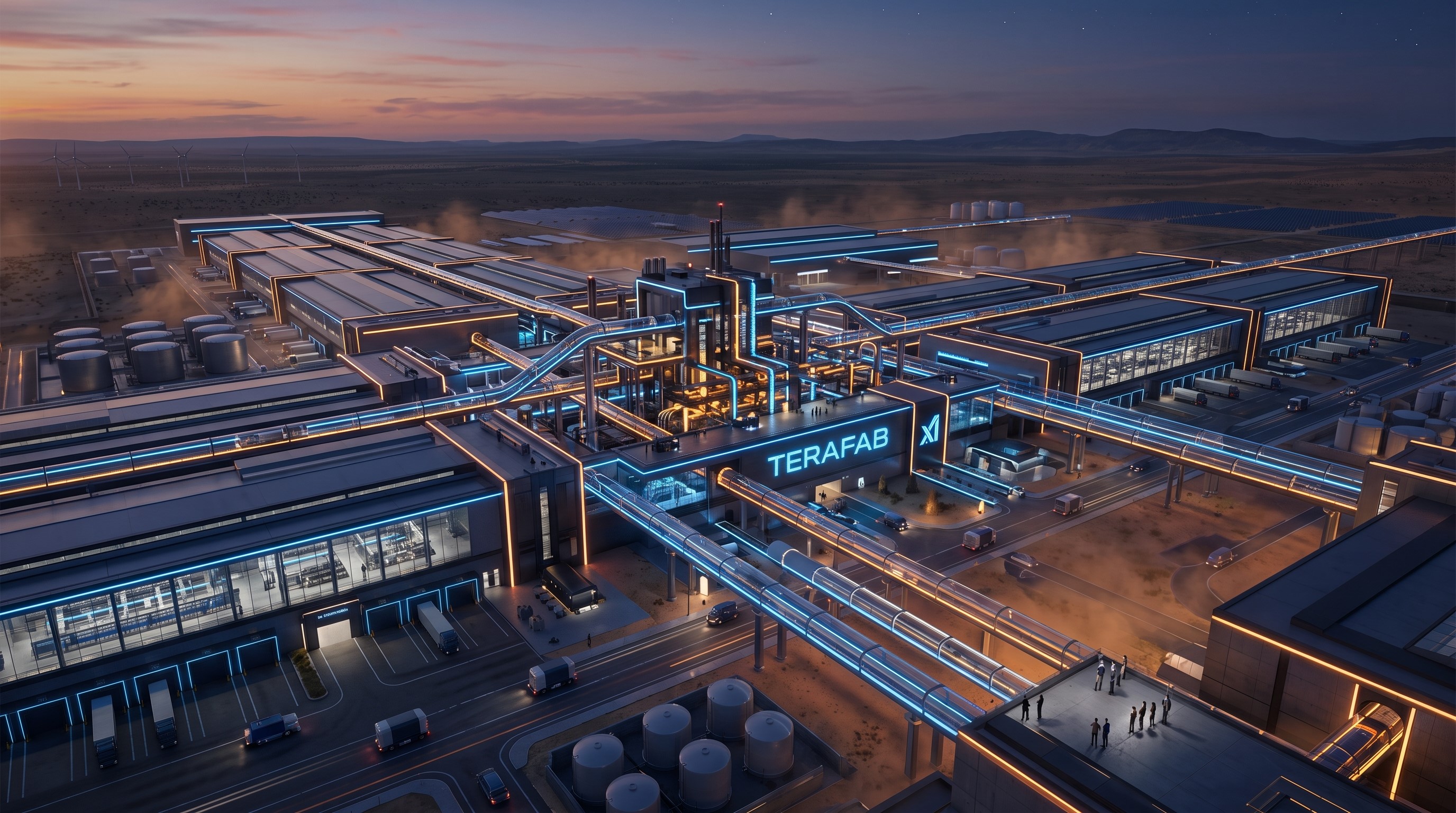
In the fast-moving tech landscape of 2026, the artificial intelligence explosion has officially collided with physical reality. For the last three years, the narrative was dominated by software breakthroughs, algorithmic optimizations, and massive GPU purchases. But as we’ve discussed before on Y2K To Go, compute isn’t an abstract cloud concept—it is a physical product forged in cleanrooms, bound by power grids, and constrained by silicon supply chains.
Enter Terafab.
Announced earlier this year as an unprecedented joint venture between SpaceX, Tesla, xAI, and semiconductor titan Intel, Terafab is not just another manufacturing plant. It is a proposed 100-million-square-foot vertically integrated chip ecosystem designed to produce an staggering 1 terawatt (1,000 gigawatts) of computing capacity per year. Planned across prototype sites in Austin and a massive main complex in Grimes County, Texas, Terafab represents the most audacious industrial bet in semiconductor history.
Elon Musk’s core premise is simple yet terrifying for existing supply chains: current global semiconductor foundries—including TSMC, Samsung, and SK Hynix—produce barely 2% of the total edge inference, robotic, and orbital compute required for the next decade of autonomous systems and AGI.
To the casual tech enthusiast, Terafab sounds like the ultimate silver bullet for the global AI compute bottleneck. But for enterprise leaders, infrastructure architects, and cloud strategists, Terafab raises critical questions. Can vertical integration overcome the brutal economic history of mega-foundries? Will energy constraints grind it to a halt? And what does this colossal shift mean for the foundational building blocks of new and existing businesses?

1. The Monolith: Inside the Terafab Architecture
To appreciate what Terafab is attempting, one must understand how fractured the semiconductor industry currently is. Today, building a single AI accelerator is an agonizing global relay race:
- Design: Silicon architecture is drafted in California or Europe (NVIDIA, AMD, Arm).
- Fabrication: Photolithography equipment from ASML in the Netherlands is shipped to Taiwan (TSMC) to etch circuitry onto 300mm silicon wafers at sub-2nm nodes.
- Memory: High-Bandwidth Memory (HBM3e/HBM4) is manufactured separately in South Korea (SK Hynix, Samsung).
- Packaging & Testing: Wafers and memory dies are shipped back across Asia for advanced CoWoS (Chip-on-Wafer-on-Substrate) packaging and final validation.
A single delay, geopolitical flare-up, or logistics bottleneck anywhere along this 10,000-mile chain halts global AI deployment.

* Under One Roof (Grimes County, TX) | Recursive Feedback Loop: Days to Weeks
Terafab smashes this multi-country assembly line into a single, unified mega-complex. By bringing logic fabrication (utilizing Intel’s 14A / 1.4nm node class), memory production, and 3D chiplet packaging into one physical facility, Terafab aims to reduce the design-to-production feedback loop from months to days.
If successful, this rapid recursive loop will allow engineers to modify photomasks in real time, drastically reducing the cost and time needed to iterate on custom AI chips for full self-driving vehicles (Cybercab), humanoid robotics (Optimus), and orbital satellite constellations.
2. Historical Precedents: The Ghosts of Megaprojects Past
History is littered with industrial mega-projects that promised to revolutionize manufacturing. When assessing Terafab’s viability, we must examine both the triumphs and the cautionary tales of high-stakes industrial bets.
The Successes: Vertical Integration at Scale
- Ford’s Rouge Complex (1928): Henry Ford’s flagship facility in Dearborn, Michigan, was the original Terafab. Raw iron ore, rubber, and coal entered one end of the complex, and completed Model Ts exited the other. It insulated Ford from external supplier price gouging and established the modern automotive era.
- Tesla Giga Nevada & Giga Texas (2016–Present): Musk’s earlier effort to co-locate battery cell production (with Panasonic) directly beside vehicle assembly lines slashed battery pack costs per kWh by over 70%, proving that modern gigascale vertical integration could succeed despite severe skepticism.
The Failures: Capital Sinks and Capacity Traps
- Morris Chang’s Early Foundry Lessons & WaferTech (1996): Early efforts to build standalone mega-fabs in North America without deeply integrated local ecosystems suffered massive cost overruns, yield inefficiencies, and talent shortages—proving that building cleanrooms is easy, but running high-yield fab processes is incredibly hard.
- The Foxconn Wisconsin Mirage (2017): Initially pitched as a $10 billion, 20-million-square-foot LCD manufacturing complex promising 13,000 jobs, the project was plagued by shifting market demands, political posturing, and unrealistic operational goals. It ultimately resulted in scaled-down, mostly empty facilities—a stark warning of what happens when mega-building promises outstrip operational realities.
- Intel’s Mid-2010s Node Stalls: Intel’s historical failure to execute its 10nm rollout on schedule delayed an entire generation of server architectures, handing market share to TSMC and AMD. Terafab relies heavily on Intel’s cutting-edge 14A process; any repetition of historical foundry execution delays could freeze Terafab’s timeline entirely.
3. The Power Grid Paradox: SpaceX Turbines vs. 100% Sustainable Energy
The elephant in the room for any facility attempting to deliver 1 terawatt of annual compute capacity is power consumption. A semiconductor fab complex of this magnitude requires continuous, ultra-high-reliability baseload power—a sudden voltage sag or millisecond flicker on a sub-2nm lithography line can destroy hundreds of millions of dollars in silicon wafers.

The Power Grid Paradox balances clean energy ambitions against real-world grid demands. Long-term goals incorporate solar, battery arrays, SMR nuclear, and geothermal energy, while immediate needs demand a “bring your own power” strategy using SpaceX in-house natural gas turbines to maintain 24/7 continuous baseload independent of the ERCOT grid.
The Energy Reality: “Bring Your Own Power”
Despite ambitious long-term goals of running on clean energy, Terafab will not be 100% sustainable at launch.
SpaceX’s energy leadership recently confirmed that Terafab will operate under a strict “bring your own power” strategy. Rather than waiting years for local utility hookups or relying solely on Tesla solar panels, the Grimes County complex will be powered immediately by massive, co-located natural gas power plants paired with industrial Tesla Megapack battery arrays.
The SpaceX Turbine Innovation: Breaking the 18-Month Bottleneck
The biggest hurdle to deploying gas-fired power isn’t fuel—it’s the global shortage of high-efficiency gas turbine components. The critical bottleneck lies in casting the specialized single-crystal “blades and vanes” that operate in turbine hot zones at temperatures over 3,000°F. Because world supply is virtually sold out through 2030, SpaceX has taken the unprecedented step of building its own secret blades and vanes foundry in Bastrop, Texas.
By adapting aerospace metallurgy and vacuum-casting techniques used in Starship’s Raptor engines, SpaceX aims to produce its own power-plant turbines in-house. Musk estimates this vertical integration will accelerate bringing new natural gas capacity online by up to 18 months, circumventing grid delays entirely.
The Sustainability Timeline & Orbital Off-Ramp

While natural gas will bootstrap the facility to get production online quickly, SpaceX and Tesla are concurrently scaling solar and battery manufacturing to transition the facility over time. To achieve true net-zero targets over the project’s decade-long roadmap, Terafab’s future power strategy incorporates three distinct phases:
- Phase 1 (Immediate): On-site, SpaceX-manufactured natural gas turbines backed by Tesla Megapacks.
- Phase 2 (Medium-Term): Supplemental utility solar, geothermal taps, and Small Modular Reactors (SMRs).
- Phase 3 (Long-Term / Orbital): Space-based AI compute. By producing radiation-hardened chips at Terafab, SpaceX plans to launch solar-powered “AI Compute Satellites” into Low Earth Orbit—where solar irradiance is five times stronger than on Earth with zero night cycle—offloading heavy training runs from terrestrial grids entirely.
4. Economic Engine: Jobs, Capital, and Timeline
The scale of capital and human resource allocation required for Terafab rivals historic national infrastructure initiatives like the Interstate Highway System or the Manhattan Project.
| Dimension | Project Metric & Targets |
| Total Estimated Investment | $119 Billion across all phases ($16.8B–$25B initial phase) |
| Physical Footprint | Up to 100 Million sq. ft. (Grimes County, TX complex) |
| Project Timeline | 2026 – 2034 (Initial prototype output targeted by late 2027/2028) |
| Direct Job Creation | 3,000+ high-tech semiconductor operations jobs; 15,000+ construction/engineering roles |
| Indirect Job Impact | 45,000+ regional jobs (logistics, chemical supply, grid maintenance, HVAC, AI software) |
The Talent Challenge
Creating thousands of jobs is easy on paper; filling them in the semiconductor sector is not. Operating a leading-edge sub-2nm cleanroom requires specialized lithography technicians, chemical mechanical planarization (CMP) engineers, and metrology experts—skills currently in severe shortage across North America. To combat this, the coalition is launching direct recruitment programs and technical training partnerships across Texas universities.
5. Building Blocks for Enterprise: How Terafab Impacts the AI Market
For startups, mid-market enterprises, and hyperscalers, Terafab isn’t just a giant building—it is a market-altering force that will rewrite the cost structure of compute.

5.1. The Democratization of Edge AI Hardware
Currently, building custom hardware for specialized AI tasks (autonomous robotics, smart medical devices, localized vision models) is prohibitively expensive for startups due to high NRE (Non-Recurring Engineering) mask costs. By creating a standardized, high-yield fab platform, Terafab could act as a foundry-as-a-service for edge computing—dramatically dropping chip acquisition costs for third-party businesses.
5.2. Breaking the High-Bandwidth Memory (HBM) Bottleneck
As analyzed in our previous article on RAM price volatility, memory packaging is the core bottleneck stalling modern AI infrastructure. By building advanced 3D packaging and memory fabrication directly alongside logic processing, Terafab removes the reliance on overseas memory supply chains, providing a stabilized supply of high-performance compute modules.
5.3. De-risking Cloud Dependency for Small Businesses
If Terafab successfully scales, the cost per TFLOP for inference will plummet. Smaller software enterprises will no longer be forced to pay exorbitant margins to traditional cloud hyperscalers for basic AI model hosting. They can deploy ultra-low-cost, dedicated hardware on-premise or in regional micro-data centers.
6. Leadership & Key Figures Driving the Project
Execution at this scale depends entirely on the leadership team assembled across aerospace, automotive, and semiconductor domains.

- Elon Musk (Project Lead & Visionary): Driving the capital allocation across Tesla, SpaceX, and xAI. Musk’s primary mandate is securing vertical silicon autonomy to prevent external foundries from choking the deployment pace of Tesla’s FSD/Optimus and xAI’s supercomputing clusters.
- Pat Gelsinger (Foundry & Process Advisor / Former Intel CEO): Leveraging Intel’s manufacturing assets and 14A process technology. Gelsinger’s technical background in silicon fabrication provides the operational architecture required to run complex leading-edge lithography lines.
- Greg Brockman (AI Systems Integration Lead): Focusing on co-optimizing software architecture with custom hardware, ensuring that the silicon produced at Terafab directly matches the requirements of next-generation transformer models and neural networks.
- Shivon Zilis (Executive Operations & Strategic Execution): Managing multi-entity coordination between xAI, Tesla, and external supply chain partners to ensure facility milestones and infrastructure permits remain on schedule.
Conclusion: Settlement Phase of the AI Revolution
Terafab represents a pivotal moment in technology. It is a tacit admission that software progress can no longer outpace physical infrastructure. The hyper-growth “gold rush” phase of purchasing off-the-shelf accelerators from a single dominant supplier has hit its physical limits.
If Terafab fails, it will join the ranks of Foxconn Wisconsin as a $100B cautionary tale of industrial hubris, crushed by power grid realities and semiconductor yield curves. But if it succeeds, it will completely rewrite the economics of artificial intelligence—transforming compute from a scarce, expensive luxury controlled by a few giants into an abundant, localized commodity that powers the next generation of global industry.

References:
- Wikipedia, 2026. “Terafab Joint Semiconductor Initiative.” https://en.wikipedia.org/wiki/Terafab
- Parametric Architecture, Aug 26, 2026. “Elon Musk’s $119B Terafab Could Become the Largest Building on Earth.” https://parametric-architecture.com/elon-musks-terafab/
- Built In, May 06, 2026. “Elon Musk’s Terafab Project: What to Know About His Chip Plan.” https://builtin.com/articles/elon-musk-terafab-project
- Blockchain Council, March 30, 2026. “TERAFAB Explained: Elon Launched a New AI Chip Fab in Texas.” https://www.blockchain-council.org/ai/terafab-elon-launched-austin-ai-chip-fab/
- TechPowerUp, April 07, 2026. “Intel Joins Terafab Project for Next-Gen Foundry Manufacturing.” https://www.techpowerup.com/forums/threads/intel-joins-elon-musks-terafab-project.348056/
- Tesla Careers, Aug 2026. “Terafab Engineering & Facility Operations Job Postings.” https://www.tesla.com/careers/search/?department=terafab
- TechCrunch, Aug 07, 2026. “SpaceX’s Terafab will rely on natural gas power plants, not Tesla solar panels.” https://techcrunch.com/2026/08/07/spacexs-terafab-will-rely-on-natural-gas-power-plants-not-tesla-solar-panels/
- TechCrunch, Aug 30, 2026. “Musk’s faster path to more gas turbines comes with pollution problem.” https://techcrunch.com/2026/08/30/musks-faster-path-to-more-gas-turbines-comes-with-pollution-problem/
Leave a Reply