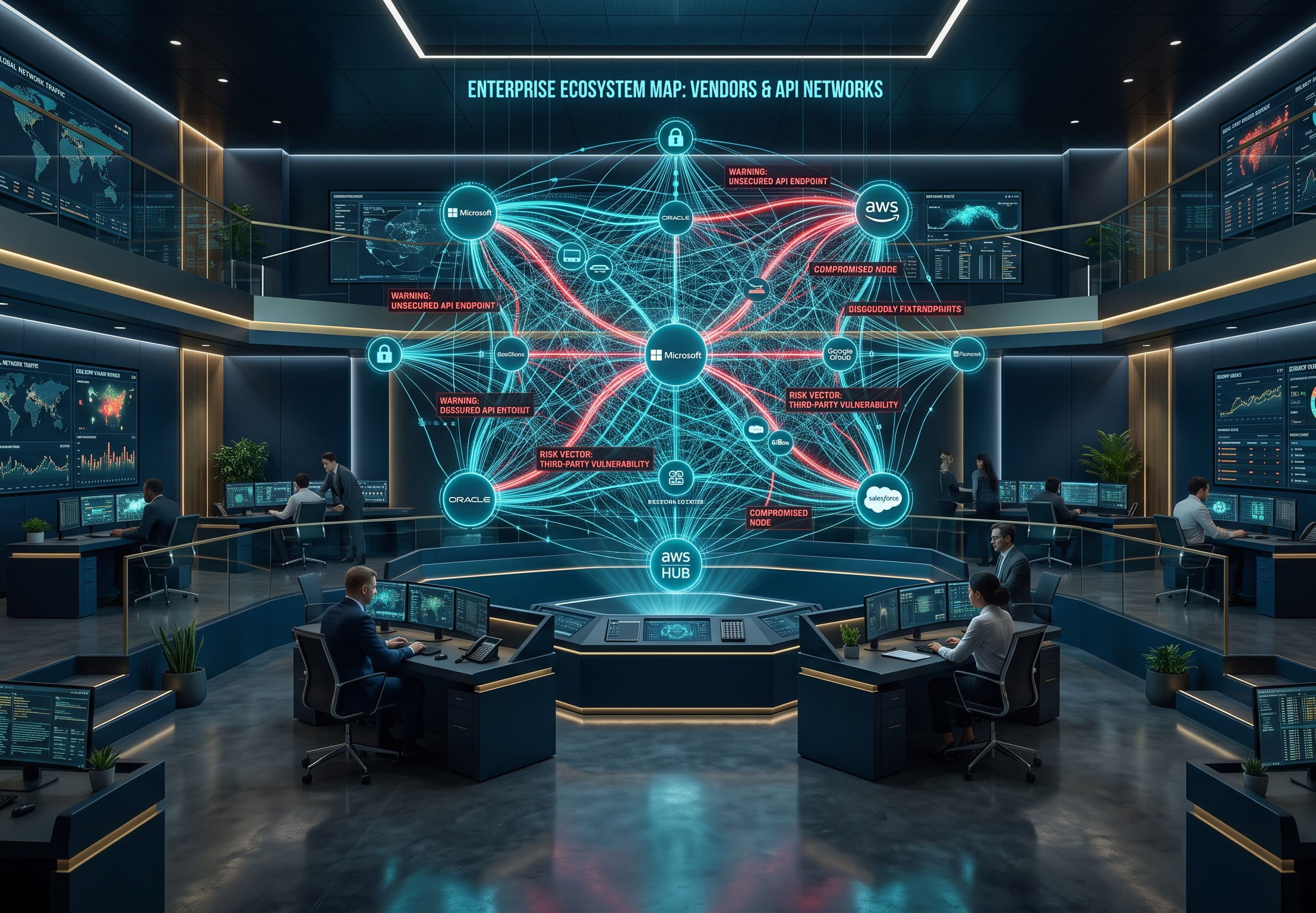
In the high-stakes landscape of 2026, automation is no longer an competitive advantage—it is the baseline for enterprise survival. From AI-driven hyper-automation pipelines to cloud-native supply chain orchestration, organizations are aggressively delegating critical operational loads to third-party software vendors. The promise is irresistible: lower overhead, instant scalability, and algorithmic precision.
Yet, beneath this rapid digital transformation lies a structural fragility that few boardrooms are prepared to acknowledge. As companies tie their core business logic to external microservices, automated APIs, and third-party AI agents, their operational perimeter dissolves. A single unvetted vendor, an unverified code update, or a financially unstable SaaS provider can trigger a systemic collapse overnight.
To the untrained eye, onboarding a new automation platform looks like a triumph of efficiency. But to risk architects and infrastructure leaders, every third-party integration is an unmonitored back door into the enterprise engine. Onboarding vendors without a rigorous, automated Risk Management process is the digital equivalent of building a skyscraper on shifting sand.
This post dissects the mechanics of Third-Party Risk Management (TPRM), evaluates the critical variables required to audit vendor viability, analyzes real-world enterprise collapses born from vendor miscalculations, and explores how AI-driven risk assessment platforms are rewriting the rules of corporate resilience.
1. The Paradox of Automatization: Efficiency vs. Exposure
The rush toward enterprise “automatization”—the systematic transformation of manual workflows into self-executing digital processes—has fundamentally altered the nature of corporate risk. Historically, operational risk was localized. If an internal database failed or a manual entry team made an error, the fallout was contained within a single department.
Today, automated architectures are deeply interconnected via API hooks, continuous integration pipelines, and automated data exchanges. When an enterprise integrates a third-party automation vendor to handle payroll, customer authentication, cloud infrastructure provisioning, or AI analytics, it effectively grants that vendor root-level trust across its operational ecosystem.

This creates a systemic paradox: the very software integrated to streamline operations introduces an unvetted vector for operational catastrophe. If the vendor’s code contains a memory leak, a supply-chain vulnerability, or a breaking API schema change, the automated process executes that failure at scale and at speed—often before human operators even detect the anomaly.

2. Onboarding Third-Party Vendors: The High-Stakes Balancing Act
Outsourcing automation functionality to specialized vendors is inevitable. No enterprise can build every piece of its tech stack in-house. However, onboarding a vendor requires balancing immediate velocity against long-term operational exposure.
The Strategic Advantages (Pros)
- Instant Time-to-Market: Integrating an established software-as-a-service (SaaS) or AI automation platform eliminates years of internal development, testing, and maintenance.
- Domain Specialization: External vendors dedicate 100% of their engineering resources to solving a specific niche problem (e.g., zero-trust identity verification, automated tax compliance), producing superior features and edge-case handling.
- Elastic Scalability: Modern cloud automation platforms automatically scale computing capacity based on demand, reducing capital expenditure (CapEx) for physical infrastructure.
The Hidden Vulnerabilities (Cons)
- Supply Chain Dependency: The enterprise becomes vulnerable to the vendor’s operational uptime, cybersecurity posture, and financial health.
- Fourth-Party Risk (Nth-Party Risk): Vendors rely on their own sub-contractors and cloud infrastructure providers. An enterprise is not just inheriting the vendor’s risk, but the entire downstream web of software dependencies.
- Data Sovereignty & Compliance Failures: Transferring proprietary enterprise data into a vendor’s automated processing engine risks violating regulatory frameworks such as GDPR, HIPAA, or SOC 2 if the vendor lacks strict data isolation.
- Lock-in and Vendor Inertia: Over-reliance on proprietary vendor APIs makes migrating to alternative solutions prohibitively expensive and complex.
3. The 6 Non-Negotiable Variables of Vendor Evaluation
A superficial review of a vendor’s marketing deck or SOC 2 Type II report is no longer sufficient. Enterprise risk assessment processes must evaluate six core variables before initiating vendor onboarding:
| Evaluation Variable | Focus & Scope | Critical Risk Question |
| 1. Financial Stability & Valuation | Balance sheet health, runway, debt structures. | Will this vendor exist in 24 months, or will sudden insolvency freeze our pipelines? |
| 2. Company Size & Maturity | Engineering bandwidth, support footprint, governance. | Does the vendor have dedicated security teams, or are developers deploying directly to production? |
| 3. Market Longevity & Track Record | Historical uptime, mean time to recovery (MTTR), SLA compliance. | How has the vendor handled major outages or security incidents in the past? |
| 4. Ecosystem & Sub-Vendor Web | Fourth-party dependencies, host infrastructure, external APIs. | What underlying cloud providers or sub-processors does this vendor rely on to deliver service? |
| 5. Implementation Success Rate | Verifiable enterprise deployments, churn rate, SLA fulfillment. | What percentage of similar-scale enterprise implementations succeeded on budget and on time? |
| 6. Infrastructure Criticality | System tiering, data sensitivity, replacement complexity. | If this vendor vanishes tomorrow, does our core business halt immediately? |
A Deeper Look at System Criticality
The depth of a risk assessment must scale proportionately with the criticality of the application being substituted or automated.
If a vendor provides an automated social media scheduling tool (Low Criticality), a streamlined risk assessment suffices. However, if the vendor provides an automated kernel-level endpoint agent, an automated treasury settlement pipeline, or an AI-driven loan underwriting engine (High Criticality), the vendor must undergo zero-trust architectural review, source code analysis, continuous vulnerability monitoring, and financial stress testing.
4. Historical Anatomy of Vendor Collapses and Supply Chain Disasters
When enterprises fail to properly evaluate third-party risks, the consequences extend far beyond minor service interruptions. History provides cautionary tales of major organizations brought down by poor vendor management and unvetted third-party integrations.
Case 1: The CrowdStrike / Delta Air Lines Incident (2024)
In July 2024, a single flawed channel file update pushed by cybersecurity vendor CrowdStrike to its Falcon platform crashed over 8.5 million Microsoft Windows machines worldwide.

Delta Air Lines was among the hardest hit, canceling over 7,000 flights over five days and suffering estimated losses exceeding $500 million. The core failure was a breakdown in vendor testing, combined with enterprise dependence on an automated vendor update system operating at the kernel level without phased deployment controls or safe fallback mechanisms.
Case 2: The Knight Capital Group Collapse (2012)
In August 2012, market maker Knight Capital Group deployed automated high-frequency trading software containing legacy code that had not been properly audited or isolated during deployment.
In just 45 minutes, the unvetted automated software executed millions of erroneous trades, losing $440 million—nearly quadruple the company’s annual net income. Knight Capital went into financial shock and was forced into a fire-sale acquisition by GETCO shortly thereafter. This stands as a classic example of automated software deployment where vendor execution risks were disastrously misread.
Case 3: The Target / Fazio Mechanical Data Breach (2013)
In late 2013, retail giant Target suffered one of the largest corporate data breaches in history, compromising 40 million payment cards and the personal information of 70 million customers.
The entry point was not a zero-day exploit in Target’s core servers; it was stolen credentials from Fazio Mechanical Services—a third-party heating, ventilation, and air conditioning (HVAC) vendor that had remote access to Target’s network for billing and energy management. Target failed to enforce network segmentation and vendor privilege limits, allowing a small HVAC vendor to become the gateway to the company’s financial records, resulting in over $200 million in direct breach costs.
5. Modern Evolution: AI-Driven Third-Party Risk Management (TPRM)
To prevent these systemic failures, forward-thinking enterprises are discarding traditional, manual risk management approaches. Historical vendor risk assessments relied on static, annual PDF questionnaires—a process that was slow, labor-intensive, and outdated the moment it was completed.

Modern organizations are adopting Automated & AI-Driven TPRM Software to transform vendor evaluation into a real-time, continuous processModern organizations are adopting Automated & AI-Driven TPRM Software to transform vendor evaluation into a real-time, continuous process.
Leading Automated TPRM Platforms
- Prevalent & OneTrust: Enterprise risk platforms that automate vendor discovery, score vendor financial and cybersecurity risks, and map sub-vendor relationships using machine learning algorithms.
- BitSight & SecurityScorecard: Platforms providing real-time external security ratings by continuously scanning vendor attack surfaces, IP spaces, leaked credentials, and patch management cadence.
- ServiceNow TPRM & Whistic: Workflow orchestration engines that automate vendor onboarding, integrate live threat intelligence feeds, and dynamically adjust vendor risk scores based on API behavior and compliance telemetry.
How AI Transforms the Risk Lifecycle
- Automated Offboarding & Deprovisioning: When a vendor contract terminates or a risk threshold is breached, automated orchestration workflows instantly revoke API access tokens, close network tunnels, and archive data connections to prevent shadow IT exposure.
- Automated Document & SOC Audit Parsing: Generative AI models ingest hundreds of pages of SOC 2 reports, ISO certifications, and financial statements in seconds, flagging compliance gaps and security exceptions automatically.
- Continuous Security Telemetry: Instead of trusting vendor self-assessments, AI risk engines continuously monitor dark web leak sites, vulnerability databases, and network traffic to detect vendor security degradation before a breach occurs.
6. Framework for a Bulletproof Risk Assessment Process
Building a resilient vendor onboarding pipeline requires a structured, multi-stage governance framework. Organizations should implement a four-tier automated risk assessment pipeline:

Phase 1: Automated Discovery & Scope Intake
- Identify the exact business logic, infrastructure components, or sensitive data assets the vendor will access or replace.
- Map all required API integrations, data flows, and automated privileges.
Phase 2: Dynamic Criticality Tiering
- Tier 1 (Mission-Critical): Direct access to core databases, payment pipelines, kernel-level OS access, or customer PII. Requires full technical, financial, and architectural audit.
- Tier 2 (Operational): Access to non-sensitive workflows, internal comms, or secondary tools. Requires standard compliance verification and continuous monitoring.
- Tier 3 (Low Impact): Standalone utilities with zero network access to internal core networks. Requires automated basic security checks.
Phase 3: Comprehensive Multi-Variable Audit
- Audit financial health, corporate ownership, sub-vendor webs, and historical deployment success rates.
- Perform automated vulnerability scans and verify data encryption standards (in transit and at rest).
Phase 4: Continuous SLA & Telemetry Enforcement
- Define automated contract triggers: If vendor uptime falls below 99.99% or a security rating drops below threshold, automated alerts execute fallback procedures or sandbox traffic.
- Require vendor commitment to phased updates, preventing unvetted global updates from executing automatically across production infrastructure.

Conclusion: The Survival of the Prepared
Automation and AI are accelerating business velocity at an unprecedented scale. However, speed without governance is simply a faster path to operational failure.
The vendor collapses of recent years demonstrate that no organization exists in isolation. As companies continue to integrate third-party software, AI agents, and automated microservices, the strength of their enterprise infrastructure will depend directly on the rigor of their vendor risk management process.
By replacing static annual audits with continuous, AI-driven risk assessments, evaluating vendor health across all six critical dimensions, and enforcing zero-trust integration boundaries, modern enterprises can harness the power of vendor automation without falling into the automated abyss.

References:
- Gartner Research, Nov 14, 2025, “Top Strategic Technology Trends for 2026: Managing Third-Party & AI Vendor Risk.” https://www.gartner.com/en/information-technology/insights/vendor-risk-management
- CrowdStrike / Delta Outage Analysis, July 22, 2024, “Systemic Risks in Kernel-Level Software Deployment and Vendor Dependencies.” Financial Times Tech Review.
- U.S. Securities and Exchange Commission (SEC), Aug 2012, “Administrative Proceeding File No. 3-15570: In the Matter of Knight Capital Americas LLC.” https://www.sec.gov/litigation/admin/2013/34-70694.pdf
- Harvard Business Review, Feb 18, 2025, “The Hidden Cost of Cloud Vendor Lock-In and Fourth-Party Dependencies.” https://hbr.org/2025/02/managing-fourth-party-vendor-risk
- BitSight Security Insights, March 2026, “Continuous Cyber Risk Monitoring vs. Static Compliance Questionnaires in Enterprise Risk Management.” https://www.bitsight.com/blog/continuous-monitoring-2026
- ISACA Journal, Vol 2, 2026, “Automating Third-Party Risk Management with Generative AI and Continuous Telemetry.” https://www.isaca.org/resources/isaca-journal
Leave a Reply