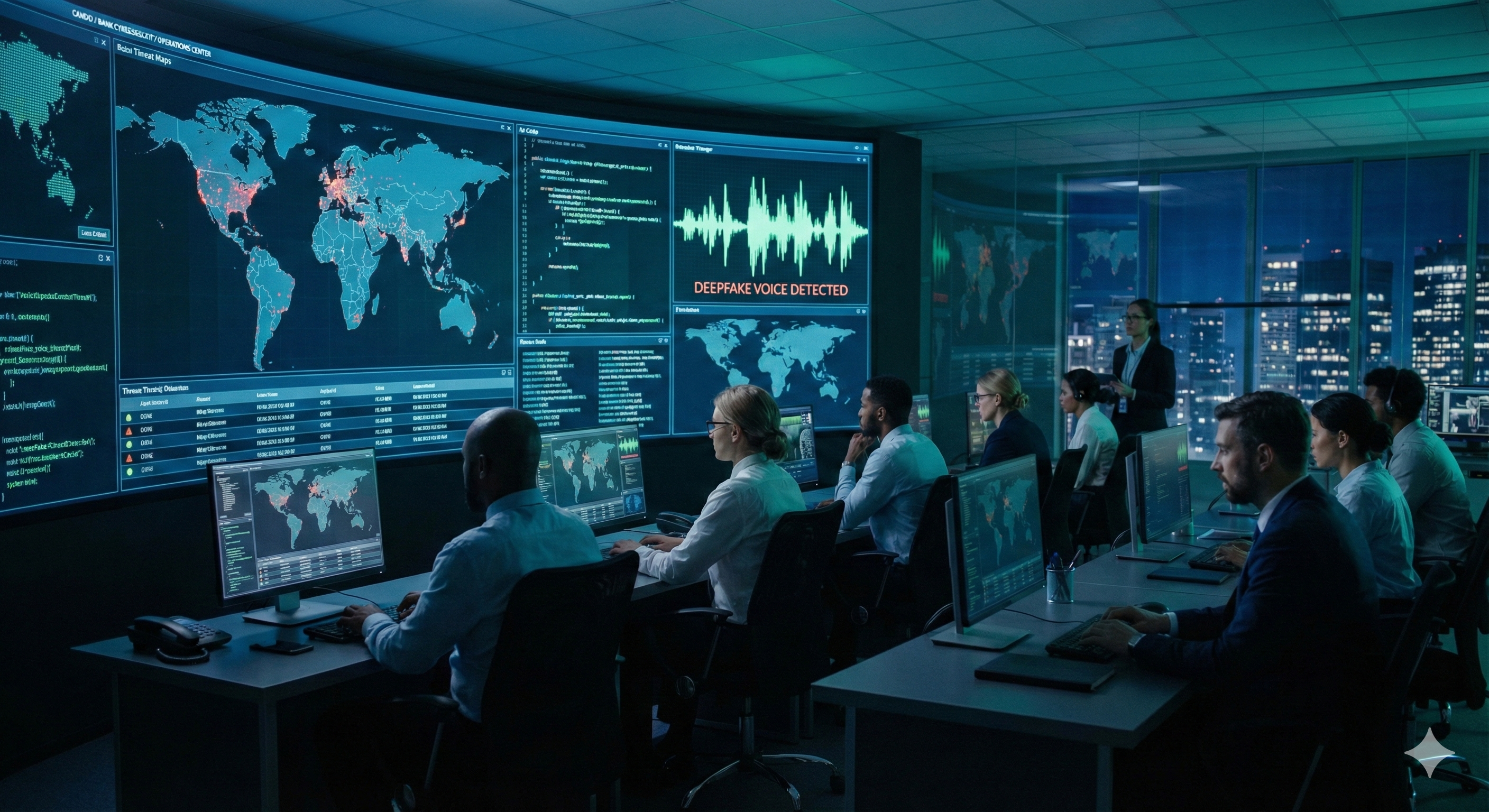
In the collective imagination, a bank robbery is a visceral, chaotic event: masked figures shouting commands, the adrenaline-fueled screech of tires, and the wail of approaching sirens. It is a physical violation of a physical space. But as we close out 2025, that image is as antiquated as the stagecoach heist.
Today, the vault door is digital, the robbers operate from unmarked office parks in adversarial nations, and the weapon of choice isn’t a firearm—it is a line of code.
For the banking industry, 2025 has been a watershed year. We have witnessed the threat landscape evolve from simple data theft to existential operational risks. The “Third Wave” of cybercrime is here, characterized by weaponized Artificial Intelligence, the looming shadow of quantum computing, and a global regulatory landscape that has finally bared its teeth.
The old fortress mentality—building higher walls around the data center—is dead. The new reality is a fluid, high-stakes game of 4D chess played at the speed of light. This post dissects the critical pillars of modern banking cybersecurity, analyzing the frequency of audits, the harsh reality of budget allocation, and the double-edged sword of AI.
1. The Pulse Check: Frequency of Security Audits
There was a time, perhaps only five years ago, when a bank could conduct an annual penetration test, check a compliance box for regulators, and consider itself secure. That era is over. In the current landscape, the speed of exploit development—often automated by AI agents—means that a vulnerability discovered today could be weaponized by tomorrow afternoon.
The “Continuous” Standard
The industry standard has shifted dramatically from annual or quarterly audits to Continuous Security Validation (CSV). Leading financial institutions now employ automated “red teams”—sophisticated software suites that relentlessly attack the bank’s own systems 24/7. These tools simulate the behavior of real-world adversaries, probing for weak points in firewalls, API endpoints, and cloud configurations. The goal is simple: find the open window before the thief does.
The DORA Effect
This shift isn’t just driven by paranoia; it is driven by law. With the European Union’s Digital Operational Resilience Act (DORA) taking full effect in January 2025, banks operating in or with Europe are now legally mandated to prove they can withstand, respond to, and recover from ICT (Information and Communication Technology) incidents. DORA has effectively killed the “checklist” approach to auditing. It replaces it with a requirement for Threat-Led Penetration Testing (TLPT).
- The New Schedule: While PCI DSS still technically allows for annual testing, high-security banking environments now default to quarterly comprehensive penetration tests, supplemented by daily automated vulnerability scans.
- The “Assume Breach” Mentality: Audits are no longer about proving you are secure; they are about proving how fast you can detect a breach that has already happened. The metric that matters in 2025 is not “number of attacks blocked,” but “dwell time”—the time an attacker sits inside the network before being detected.
2. The Human Firewall: Training for the Deepfake Era
The most sophisticated firewall in the world, costing millions of dollars, cannot stop an employee from handing over the keys if they are tricked into doing so. The “Human OS” remains the most unpatchable vulnerability in the security stack. However, the nature of “social engineering” has changed terrifyingly in the last 12 months.
The Failure of Annual Training
Studies conducted throughout 2025 have solidified what many CISOs suspected: annual security training is functionally useless. Retention rates for security protocols drop by nearly 90% within 30 days of a training session. To be effective, banks are now implementing micro-learning simulations every 90 days.
The Gamification Imperative: To boost employee engagement and knowledge retention, many leading banks have adopted gamified training models. Instead of mandatory slideshows, employees compete in live security simulations, earning points or non-monetary rewards for correctly identifying phishing attacks, reporting suspicious behavior, or successfully navigating a simulated system breach. This approach transforms a security chore into a competitive skill, with some institutions reporting a 40% reduction in careless clicks after implementation.
The Deepfake Crisis
The most significant shift in 2025 is the weaponization of Generative AI. We are no longer just looking for misspelled emails or “Nigerian Prince” scams. We are fighting “CEO Fraud” where attackers use AI to clone the voice and video likeness of bank executives.
- The Stats: Recent data indicates that deepfake-enabled fraud attempts have surged by 2,137% over the last three years. In the first half of 2025 alone, the financial sector lost an estimated $410 million to deepfake fraud—a figure that exceeds the losses of the previous two years combined.
- New Protocols: Modern training now requires employees to verify identities through “out-of-band” communication. If the CFO calls via video asking for an urgent wire transfer, the protocol is to hang up and call them back on a verified internal line. Trusting your eyes and ears is no longer a safe option.
3. The Price of Protection: Budget Allocation
Cybersecurity is no longer an IT line item nestled somewhere between server maintenance and software licensing; it is a board-level imperative. The cost of doing business now includes a massive “protection tax.”
The 15% Rule
Historically, banks allocated roughly 5–8% of their total IT budgets to cybersecurity. In 2025, that number is woefully insufficient. The new benchmark for resilience is 10% to 15% of the total technology budget.
Where is the Money Going?
The spending has shifted away from perimeter defense.
- Identity and Access Management (IAM): With remote work and cloud banking, “identity is the new perimeter.” Heavy investment is pouring into biometric authentication and Zero Trust Architecture.
- Cyber Insurance: Premiums have skyrocketed. Banks are spending a significant portion of their budget just to maintain coverage, which now requires them to meet rigorous security standards just to qualify for a policy.
- Retiring Technical Debt: A hidden cost is the retirement of legacy systems. Mainframes running COBOL code from the 1980s can no longer be adequately patched against modern threats. A significant portion of the 2025 budget is dedicated to modernizing this infrastructure to eliminate these “legacy holes.”
4. AI: The Guardian and the Threat
Artificial Intelligence is the protagonist and the antagonist of this story. It is an arms race where both sides are using the same weaponry.
The Defender: AI as the Watchdog
AI is now essential for Anomaly Detection. Traditional rule-based systems (e.g., “flag any transfer over $10,000 sent to a new country”) produce too many false positives, annoying customers and fatiguing security staff.
- Behavioral Biometrics: AI systems in 2025 analyze thousands of variables per transaction in milliseconds. They look at the device fingerprint, the angle at which a user holds their phone, their typing cadence, and their geolocation history.
- The Result: Reports indicate AI detection tools have improved fraud blocking rates by roughly 60% while simultaneously reducing customer friction by identifying “trusted” patterns that don’t need manual review.
The Attacker: AI as the Lockpick
Conversely, criminal syndicates are using “WormGPT” and other malicious Large Language Models (LLMs) to automate their attacks.
- Polymorphic Malware: Attackers use AI to write code that changes its own signature every time it replicates, rendering traditional antivirus software useless.
- Automated Reconnaissance: In a widely cited 2025 incident, a multinational bank suffered a breach where AI was used to scan thousands of API endpoints in minutes to find a single unpatched vulnerability (Broken Object Level Authorization, or BOLA). What used to take hackers weeks of manual probing now takes seconds.
5. The Shadow Risk: Governing Internal AI
The biggest cybersecurity blind spot in 2025 is not the attacker’s AI, but the bank’s own. As departments rapidly adopt generative AI tools (like internal ChatGPT deployments or Agentic AI—autonomous systems that can make decisions and take actions), they introduce new, unmanaged risks: Shadow AI and the danger of “Agentic Failure.”
- Shadow AI Risk: This occurs when employees use public or unapproved AI tools to handle sensitive data (e.g., pasting customer data into a public large language model (LLM) for summarization). This violates data privacy laws and exposes proprietary information. Up to 70% of companies report dealing with significant Shadow AI usage. The bank must establish guardrails to detect, monitor, and regulate the use of all AI tools.
- The Autonomous Agent Problem: The next evolution is Agentic AI, where systems perform multi-step financial tasks automatically (e.g., an AI agent underwriting a loan or flagging a complex AML transaction). If these agents are not secured with rigorous identity and access controls, a hijacked agent could become an undetectable, high-privilege insider threat.
- Regulatory Focus: Regulators (like the FFIEC in the US) are increasingly focused on model risk management, demanding transparency and auditability for AI used in critical functions. Banks must prove their AI is secure, unbiased, and compliant with all privacy regulations before it is deployed.
6. The Invisible Door: API and Supply Chain Risks
As banks embrace “Open Banking” to share data with fintech apps, budget trackers, and payment platforms, they have inadvertently opened thousands of back doors.
The API Vulnerability
APIs (Application Programming Interfaces) now make up over 57% of all dynamic internet traffic. They are the glue of the modern web, but they are often left unguarded. Studies have shown that 84% of financial organizations have API protections that are “significantly misaligned” with the sensitivity of the data they expose.
- The Threat: The primary vector is BOLA, where an attacker logs in as User A but changes the ID in the URL to view User B’s account. Because the API assumes the user is logged in, it often fails to double-check authorization for that specific object.
The Supply Chain Weakness
It is rarely the bank itself that gets hacked directly; it is the vendor. Whether it is a third-party chatbot provider, a cloud storage service, or a payroll processor, attackers are pivoting to the supply chain to bypass the bank’s primary defenses. This has forced banks to demand a “Software Bill of Materials” (SBOM) from all vendors to understand exactly what code is running in their environment.
Case Example: The Third-Party Domino Effect: The consequences of vendor risk were starkly illustrated in 2025 when a single third-party payment processing vendor, utilized by hundreds of financial institutions, was compromised. Attackers leveraged the vendor’s privileged access to deploy ransomware that crippled payment services across multiple banks simultaneously. This incident was a wake-up call, emphasizing that a bank’s security perimeter is only as strong as its weakest partner.
7. The Insider Threat: The Enemy Within
While we fear the hooded hacker in a dark room, the data points to a more uncomfortable truth: the call is often coming from inside the house.
- The Cost: The average annual cost of insider threats—whether from negligent employees or malicious spies—has risen to $17.4 million per organization.
- The Negligent Insider: This is the most common type. It is the employee who bypasses security controls to “get the job done” faster, or the exhausted staffer who clicks a link they shouldn’t have.
- The Malicious Insider: In 2025, we have seen a rise in “recruited” insiders. Criminal groups are actively approaching bank employees via encrypted messaging apps (like Telegram) and offering them significant sums of crypto-currency in exchange for credentials or access. 83% of organizations report experiencing at least one insider attack annually.
8. The Future Horizon: Quantum Preparedness
Finally, we must look at the threat that hasn’t fully arrived but is already dangerous: Quantum Computing.
Harvest Now, Decrypt Later
Nation-state actors are currently engaged in a strategy known as “Harvest Now, Decrypt Later.” They are stealing massive amounts of encrypted data that they cannot yet read and storing it in data centers. They are waiting for “Q-Day”—the moment a quantum computer is powerful enough to break standard encryption algorithms (RSA and ECC).
The Preparation
Banks are under immense pressure to inventory their cryptographic assets immediately. Estimates suggest that delaying the migration to Post-Quantum Cryptography (PQC) could cost a bank significantly more in remediation costs later. The transition must start now to ensure that when Q-Day arrives, the vault doors don’t simply swing open.
Conclusion: Volume vs. Value—The Banking Imperative
Analysis of the 2025 threat landscape reveals a critical distinction between the sheer volume of attacks and the financial severity of breaches. While the total number of data compromises reported in the United States alone is projected to exceed 3,100 for the full year, the key concern for the industry is not frequency but cost. The global average cost of a data breach stands at $4.44 million, yet the Financial Services sector faces the second-highest costs globally (after Healthcare), with an average cost per breach reaching $5.56 million. This premium is driven by the high value of financial data, stringent regulatory penalties, and the prevalence of sophisticated, malicious attacks, which account for 51% of all financial sector breaches. Furthermore, attackers are increasingly leveraging indirect access, with Supply Chain Compromise being a dominant and costly entry vector, and AI-driven attacks now involved in roughly one in six breaches, demonstrating that while banks may successfully repel the highest volume of common attacks, the ones that penetrate their defenses carry an exponentially higher price tag.

Designed with WordPress
References:
- Alpay, Pinar; Birch, David, 2025, “Identity Fraud Report: The Battle in the Dark,” Signicat, https://www.signicat.com/the-battle-in-the-dark
- Aziz, S.; Amjad, A.; Persaud, N. et al., December 10, 2025, “The AI dilemma: Securing and leveraging AI for cyber defense,” Deloitte, https://www.deloitte.com/us/en/insights/topics/technology-management/tech-trends/2026/using-ai-in-cybersecurity.html
- Bobier, J.F.; Fouilloux, C.; Lyon, V. et al., October 15, 2025, “How Quantum Computing Will Upend Cybersecurity,” Boston Consulting Group (BCG), https://www.bcg.com/publications/2025/how-quantum-computing-will-upend-cybersecurity
- Cosgrove, J.; Zejnilovic, S., January 9, 2024, “Introducing Cloudflare’s 2024 API Security and Management Report,” Cloudflare, https://blog.cloudflare.com/2024-api-security-report/
- DeepStrike, December 7, 2025, “Data Breach Statistics 2025: Global Costs and Trends,” DeepStrike, https://www.reddit.com/r/EnglishLearning/comments/1c1e8v6/report_of_or_for/
- European, Parliament and Council, December 2022, “Regulation (EU) 2022/2554 on digital operational resilience for the financial sector (DORA),” Official Journal of the European Union, https://eur-lex.europa.eu/eli/reg/2022/2554/oj
- Gallagher, Bassett, December 13, 2025, “Top 5 Cyber Threats in 2026: Continued Supply Chain and Vendor Attacks,” Gallagher Bassett, https://www.gallagherbassett.com/news-and-insights/top-5-cyber-threats-in-2026/
- IBM, 2025, “Cost of a Data Breach Report 2025,” IBM/Ponemon Institute, https://www.reddit.com/r/EnglishLearning/comments/1c1e8v6/report_of_or_for/
- Identity, Theft Resource Center (ITRC), 2025, “2025 Annual Data Compromise Report,” ITRC, https://www.reddit.com/r/EnglishLearning/comments/1c1e8v6/report_of_or_for/
- Northdoor, plc, November 27, 2025, “Financial data breaches and AI security trends: 2025 industry analysis,” Northdoor plc, https://ell.stackexchange.com/questions/35390/to-analyze-or-for-analysis
- Ponemon, Institute; DTEX Systems, April 2025, “2025 Cost of Insider Threats Global Report,” Ponemon Institute, https://ponemon.dtexsystems.com/
- PwC, November 3, 2025, “2026 Cybersecurity Outlook: Harness AI’s power while guarding against its risks,” PwC, https://www.pwc.com/us/en/services/consulting/cybersecurity-risk-regulatory/library/2026-cybersecurity-outlook.html
- Seals, J., June 18, 2024, “State of API Security Report 2024,” Salt Security, https://content.salt.security/state-api-report.html
- Security, Boulevard, November 19, 2025, “Cybersecurity in Banking: Best Practices for a Safer Future,” Security Boulevard, https://securityboulevard.com/2025/11/cybersecurity-in-banking-best-practices-for-a-safer-future/
Leave a Reply