In the fast-moving tech landscape of 2025, the “wait and see” approach to cloud migration has officially hit its expiration date. For years, sticking with on-premise servers was seen as a conservative, “safe” bet—a way to maintain control and avoid the perceived volatility of the cloud. But as we close out 2025, that “safety” has transformed into a dangerous anchor.
Today, the vault door is decentralized, and the robbers aren’t just stealing data—they are out-innovating you. While 96% of enterprises have now embraced the cloud, those remaining in the data center basement are finding themselves “AI-locked,” exposed to a new breed of infrastructure-level threats, and struggling to comply with a regulatory landscape that has finally outpaced them.
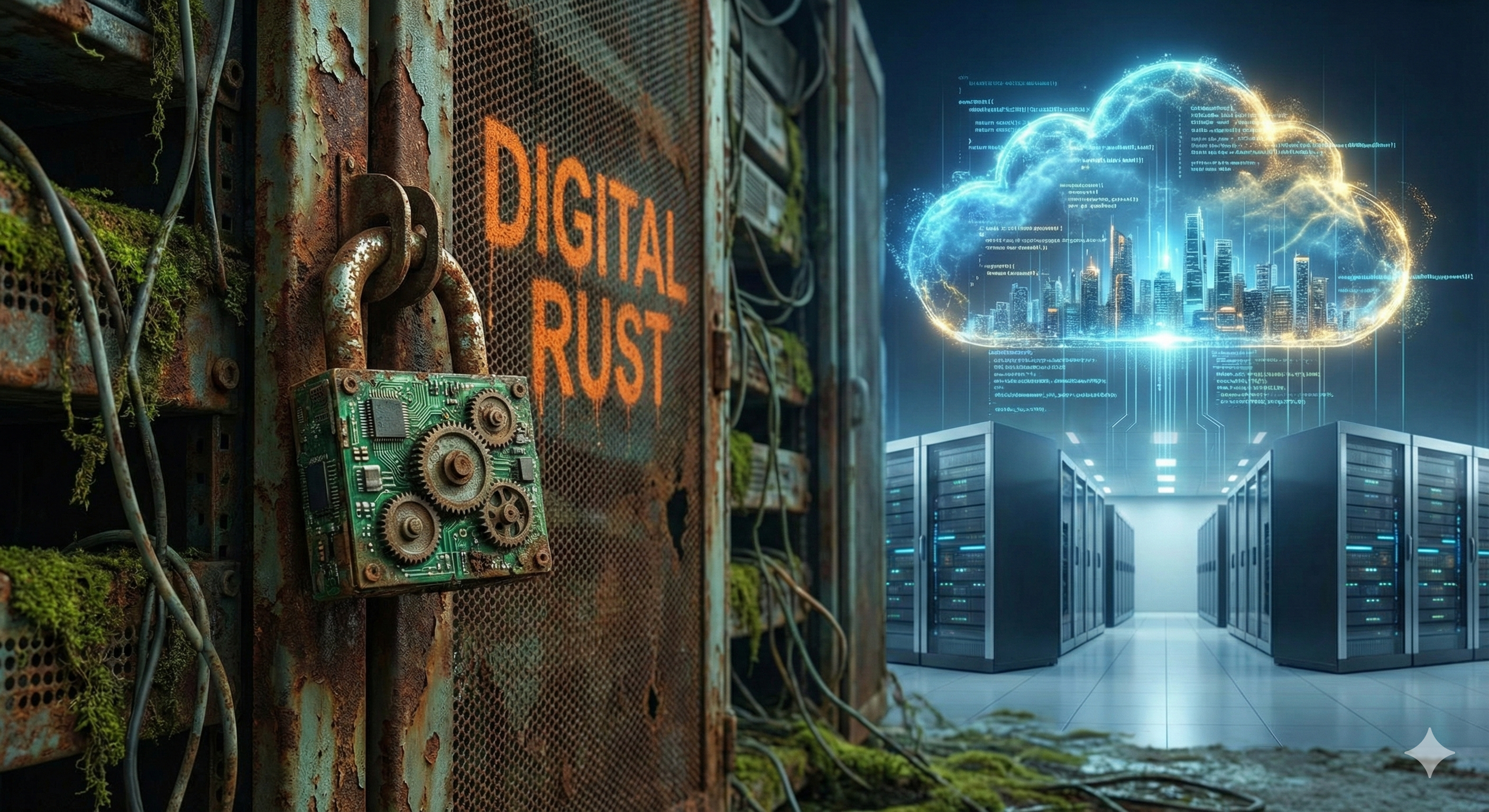
The decay of legacy systems—a phenomenon we now call “Digital Rust”—is not a sudden collapse. It is a slow, silent oxidation of a company’s ability to compete. This post dissects the nine critical pillars of modern infrastructure, from the skyrocketing cost of technical debt to the quantum-cloud frontier, providing a roadmap for those who wish to survive the next decade of digital evolution.
1. The Migration Tax: The Reality of Refactoring vs. Lifting
For years, the “Lift and Shift” (Rehosting) model was the gateway drug to the cloud. You took your virtual machine on-prem and moved it to an AWS EC2 instance. In 2025, this strategy is failing. The “Migration Tax” has arrived, and it is expensive. Reports from late 2025 indicate that while a basic rehost might cost a startup $40,000, enterprises with mission-critical workloads are seeing bills exceed $600,000 just for the move itself.
The real cost, however, is not the data transfer—it is Refactoring. Running a 20-year-old COBOL mainframe or an unoptimized SQL database in the cloud is like putting a steam engine on a high-speed rail track; it works, but it’s incredibly inefficient and costly. Research by firms like TurinTech AI shows that manual refactoring of a single legacy application can take up to 3.5 years and cost over $750,000. Projects relying on manual legacy code rewriting are six times more likely to encounter failure compared to those utilizing automated, AI-driven conversion software.
The relationship between this tax and the cloud is simple: the cloud is an accelerator, but it requires a compatible fuel. If your software is not “cloud-native”—meaning it cannot take advantage of microservices, serverless functions, and auto-scaling—you are effectively paying a premium to run inefficient software on expensive hardware. Forward-thinking companies are now spending up to 15% of their migration budget on “Code Modernization” to ensure their apps can actually handle the elastic nature of the cloud. Without this, the “cloud bill shock” of 2025 becomes a terminal illness for the IT budget, with technical debt raising cloud costs by up to 30% annually.
2. The Infrastructure Expansion Act and the $100 Billion Signal
The urgency to modernize has reached the highest levels of government. In mid-2025, the Infrastructure Expansion Act (H.R. 3548) and subsequent Executive Orders like “Winning the AI Race: America’s AI Action Plan” signaled a massive shift. While the public focused on physical bridges, the legislative heart of the bill was directed at “Digital Bridges.” The U.S. government earmarked over $100 billion for a national network of “AI-powered cloud laboratories” and rural broadband initiatives that prioritize cloud-native connectivity.
This move streamlines the regulatory process to facilitate the rapid deployment of essential AI infrastructure. For private companies, the signal is clear: the regulatory “floor” is rising. The government is investing in the cloud because it knows that’s where the next decade of growth—and defense—will happen. By revoking previous climate-related requirements in favor of expedited permitting, the current administration has signaled a “speed-to-market” mandate. Data center electricity consumption is projected to rise from 176 TWh in 2023 to between 325 and 580 TWh by 2028. Companies still on-premise are not just behind their peers; they are increasingly disconnected from a national digital strategy that relies on the hyper-scalability of cloud-hosted AI models for both economic and military superiority.
3. Globalization and the “18-Day Rule”
In the global economy of 2025, the competitive advantage is measured in days, not months. A phenomenon known as the “Expansion Wall” has hit legacy companies. When a cloud-native fintech company decides to expand into Brazil or Vietnam, they don’t buy hardware. They select a new region in their cloud console, deploy their Infrastructure-as-Code (IaC) scripts, and are live in roughly 18 days.
Compare this to a legacy giant. To enter the same market, they must navigate local real estate for a data center, source server racks (still plagued by specific AI-chip shortages), and fly out engineers for “racking and stacking.” This process takes an average of 18 months. By the time the legacy firm is ready to open its digital doors, the cloud-native competitor has already captured the market’s early adopters. This is where the cloud relationship becomes existential: global expansion is now a software configuration problem, not a construction problem. Cloud providers now offer “Sovereign Clouds” that automatically handle local compliance, allowing a business to scale without ever needing to understand the local building permits of a foreign city.
4. Resilience and the 1.6T Interconnect Era
The network is the new bottleneck. While the public is talking about “10G” fiber to the home, the internal plumbing of the data center has reached a breaking point. To support the massive data bursts required by Generative AI and real-time financial modeling, the industry has shifted to 1.6 Terabit (1.6T) optical interconnects. Early shipments of 1.6T optical modules have already begun as of December 2025, pointing to a generational leap in data-center interconnect speed.
Resilience in 2025 is no longer about having a backup generator; it is about the Network Fabric. High-speed transceivers—400G, 800G, and now 1.6T—are becoming indispensable for the interconnects between servers, storage, and switches that make up a cloud cluster. Silicon Photonics (SiPh) is gaining traction as a method to deliver this bandwidth with lower power consumption. Legacy on-premise networks, often still running on 10G or 40G backbones, simply cannot handle the “east-west” traffic (server-to-server) that modern AI agents require. When these legacy systems hit a traffic spike, they don’t just slow down; they experience “Packet Collapse,” leading to hours of total system blackout. In contrast, cloud-native resilience uses the cloud’s inherent “mesh” architecture to reroute petabytes of data in milliseconds if a single fiber line is cut.
5. The Hardware Revolution: From Fans to Liquids
If you walked into a leading-edge cloud data center today, it would be strangely quiet. The roar of thousands of server fans is being replaced by the hum of Liquid Immersion Cooling. 2025 is the year the “Air-Cooling Limit” was reached. Modern AI chips, like the NVIDIA Blackwell series, generate so much heat—surpassing 1kW per GPU—that air is no longer a viable heat-exchange medium.
Traditional enterprise racks consume 5–10 kW, but AI racks fueled by GPU clusters often require 40–100 kW per rack. Air cannot remove that much heat efficiently. To maintain 24/7 reliability, cloud providers are submerging entire server racks in dielectric, non-conductive fluids. This isn’t just a cooling gimmick; it’s a survival tactic. Immersion cooling systems reduce cooling energy costs by up to 90% compared to traditional methods, directly improving the Power Usage Effectiveness (PUE) metrics that regulators now track. Companies staying on-premise are finding that their existing data centers literally cannot provide the power density or the cooling required to run the next generation of business software. They are being forced to either build new, ultra-expensive specialized facilities or admit defeat and move to a hyperscale provider who has already invested billions in liquid-cooled “AI Pods.”
6. The Great Talent Shift: Who is Hiring and Who is Firing?
The “Server Room” team is a dying breed. In 2025, the job market has bifurcated. We are seeing the total obsolescence of the Rack Technician and the Manual System Administrator. These roles, which focused on physical maintenance and manual patching, have been replaced by automation and Infrastructure as Code (IaC).
The Cloud Career Pivot: The roles that dominate in 2025 are those that focus on orchestration and cost-efficiency. Cloud Automation Engineers focus on streamlining infrastructure using tools like Terraform or Kubernetes. FinOps Analysts act as “Cloud Accountants,” managing the variable costs of the cloud to ensure an accidental runaway AI script doesn’t cost the company $500,000 overnight. Platform Engineers build internal developer platforms that allow software teams to self-serve infrastructure without needing an IT ticket.
The risk for on-premise staff is “Skill Rot.” A SysAdmin who has only managed physical hardware for a decade finds themselves virtually unemployable in a market where 70% of IT roles now require cloud-native expertise. The relationship to the cloud here is human: the cloud hasn’t just replaced the hardware; it has replaced the work associated with the hardware.
7. The Regulator’s Hammer: DORA and Multi-Cloud Mandates
For the financial sector, 2025 has been defined by the Digital Operational Resilience Act (DORA), which became officially effective on January 17, 2025. Regulators in the EU and North America no longer just want to know if your data is secure; they want to know if you can survive a cloud provider failing.
DORA introduces a harmonized framework for managing ICT risks, mandating that financial entities establish end-to-end visibility into their digital operations. One of the most critical requirements is the “Exit Strategy.” Banks must now prove they can migrate their entire operation from one cloud provider to another within 30 days to prevent “Systemic Vendor Lock-in.” This has led to the rise of the “True Hybrid” model. In this setup, the “Crown Jewels”—sensitive customer ledgers—live in private, highly regulated clouds, while customer-facing apps and AI analytics live in the public cloud. The cloud is no longer a place you “go to”; it is a set of capabilities you must manage across multiple providers to satisfy the hammer of the law.
8. The Electrical Bill and the Green Hyperscaler
The massive energy consumption of AI data centers has made cloud providers some of the largest energy consumers on Earth. In 2025, the focus has shifted to SMRs (Small Modular Reactors) and Enhanced Geothermal Systems (Cold UTES). Microsoft and Google have recently signed landmark agreements to power their data centers with next-gen nuclear energy, aiming to provide a stable, zero-carbon source of cooling and computing power.
Interestingly, cloud data centers are now being seen as a benefit to the public grid. Research indicates that a typical 100 MW data center can generate approximately $3.4 million in surplus value that utilities can use to reduce rates for other customers. By using off-peak power to create cold energy reserves underground, geothermal storage reduces the strain on the grid. For on-premise companies, the “Green Tax” is becoming a reality. Moving to the cloud is no longer just a tech decision; it is an ESG (Environmental, Social, and Governance) strategy. Cloud providers achieve a $PUE < 1.1$, a figure impossible for an older, air-cooled private data center to reach.
9. The Electrical Bill and the Green Hyperscaler
As we approach the end of 2025, Quantum Computing has transitioned from a lab experiment to a cloud service. With the launch of Google’s Willow chip (featuring 105 superconducting qubits) and IBM’s Quantum Starling system, “Quantum Advantage” is now verifiable. However, the hardware is so specialized—requiring temperatures near absolute zero—that no individual company “owns” a quantum computer.
Instead, the cloud has become the delivery mechanism for Quantum-as-a-Service (QaaS). In late 2025, Wall Street firms deployed quantum systems via the cloud for portfolio optimization and risk analysis that traditional systems could not handle. The QaaS market reached $2.3 billion in annual revenue in 2025. This allows a bank to rent “qubit-time” for as little as $1.60 per second of quantum processing time. The relationship to the cloud is absolute: if your data is not in the cloud, you cannot connect it to the quantum-ready APIs required to run these simulations. Companies stuck on-premise are effectively barred from the quantum era.
Conclusion: The Cost of the Status Quo
Analysis of the 2025 infrastructure landscape reveals a critical truth: the gap between the “Cloud-First” and the “Legacy-Locked” is no longer a crack; it is a canyon. While the Infrastructure Expansion Act is fast-tracking the building of new digital bridges, those who refuse to cross them are being left in a world of skyrocketing energy costs, talent flight, and regulatory penalties.
The question for 2026 is no longer how to move to the cloud, but whether you have already waited too long. In 2025, the “Digital Rust” is real, and it is eating the foundations of the on-premise world.

Designed with WordPress
References:
- Congress.gov, Dec 12, 2025, “Data Center Energy Infrastructure: Federal Permit Requirements.” https://www.congress.gov/crs-product/R48762
- Mayer Brown, Aug 28, 2025, “Federal Action to Fuel Data Center Boom: The Accelerating Federal Permitting EO.” https://www.mayerbrown.com/en/insights/publications/2025/08/federal-action-to-fuel-data-center-boom
- TurinTech AI, Feb 20, 2025, “Accelerate Cloud Migration with Gen-AI powered Code Refactoring.” https://www.turintech.ai/use-cases/accelerate-cloud-migration-with-gen-ai-powered-code-refactoring#:~:text=Streamlining%20Code%20Refactoring%20with%20GenAI%3A%20Benefits%20and%20Risks&text=These%20advanced%20AI%20technologies%20can,migration%20projects%20while%20minimising%20costs.
- IT Convergence, Oct 1, 2025, “Managing Technical Debt in 2025: Strategies for Legacy Systems.” https://www.itconvergence.com/blog/strategies-for-managing-technical-debt-in-legacy-software-systems/
- GSDSolutions, Aug 4, 2025, “Cloud vs On-Premise: Which Is Best for Your Business in 2025?” https://gsdsolutions.io/cloud-vs-on-premise-2025/
- Link-PP, Dec 10, 2025, “AI Data Centers Drive Optical Transceiver Market Growth: 800G and 1.6T.” https://www.link-pp.com/knowledge/ai-optical-transceiver-market-growth-800g-cpo-silicon-photonics.html
- Technavio, 2025, “Liquid Cooling For AI Data Centers Market Growth Analysis 2025-2029.” https://www.technavio.com/report/liquid-cooling-for-ai-data-centers-market-industry-analysis
- Orca Security, Jan 2025, “Digital Operational Resilience Act (DORA) Compliance Guide.” https://orca.security/glossary/digital-operational-resilience-act-dora/
- Energy and Environmental Economics, Inc. (E3), Dec 1, 2025, “Tailored for Scale: Designing Electric Rates for Large Loads.” https://www.ethree.com/wp-content/uploads/2025/12/RatepayerStudy.pdf
- SpinQ, Oct 31, 2025, “Quantum Computing Industry Trends 2025: Breakthrough Milestones.” https://www.spinquanta.com/news-detail/quantum-computing-industry-trends-2025-breakthrough-milestones-commercial-transition
- Asapp Studio, Sept 2, 2025, “Quantum Computing 2025: Real Business Applications Now.” https://asappstudio.com/quantum-computing-2025-business-applications-guide/
Leave a Reply